"God is Spirit, and those who worship Him must worship in spirit and truth." (John 4:24)
Sermons by David Scarpino (Page 16)

The Apostle Paul recounting his meeting with Jesus on the road to Damascus says, “15 So I said, ‘Who are You, Lord?’ And He said, ‘I am Jesus, whom you are persecuting. 16 But rise and stand on your feet; for I have appeared to you for this purpose, to make you a minister and a witness both of the things which you have seen and of the things which I will yet reveal to you. 17 I will [a]deliver you from the Jewish people, as well as from the Gentiles, to whom I [b]now send you, 18 to open their eyes, in order to turn them from darkness to light, and from the power of Satan to God, that they may receive forgiveness of sins and an inheritance among those who are sanctified[c] by faith in Me.’” (Acts 26:15-18).
What an amazing event this was in Saul’s life. So powerful that it changed him forever to walk in a new direction. Saul turned from being a persecutor of God’s people, from seeking to destroy the way of Christ to preaching Christ Jesus and establishing most of the first century churches of Christ.
In this lesson the focus will come mostly from verse 18 where Paul quotes what Jesus commanded he must do, “to open their eyes, in order to turn them from darkness to light, and from the power of Satan to God, that they may receive forgiveness of sins and an inheritance among those who are sanctified[c] by faith in Me.”
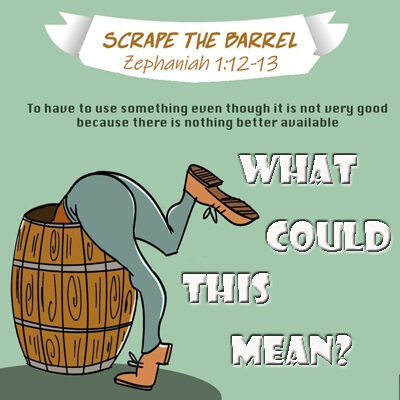
There is an idiom that goes: “To scrape the bottom of the barrel”. (Cambridge Dictionary) The idiom means “to use the worst people or things because that is all that is available:” According to Wikipedia, this idiom “Derived from the historical practice in the early European history of storing food in barrels; when food supplies ran low, only what was on the very bottom of the barrel remained, and had to be removed by scraping.” Alex Epstein in his 2014 book, “The Moral Case for Fossil Fuels” Stated the expression “scraping the bottom of the barrel” comes from the phenomenon of the oil in a barrel existing in different fractions, from heavy to light. The heavy fractions sit at the bottom of the barrel, and the heaviest, like asphaltum, which goes into asphalt, can be hard to scrape out and impossible to use.
Believe it or not—this is a bible term and was used by Zephaniah – let’s read it here: “12 “And it shall come to pass at that time that I will search Jerusalem with lamps, and punish the men who are settled[a] in complacency, Who say in their heart, the Lord will not do good, nor will He do evil.’ 13 Therefore their goods shall become booty, and their houses a desolation; They shall build houses, but not inhabit them; They shall plant vineyards, but not drink their wine.” (Zephaniah 1:12-13).
Can you guess which word captures the Idiom Scrap the Barrel. Notice the word used here, “Settled” — that is it. Strong’s says it a primitive root; MEANING to shrink, i.e. Thicken (as unracked wine, curdled milk, clouded sky, frozen water) — congeal, curdle, dark, settle. The KJV sheds a little more light on this: “And it shall come to pass at that time, that I will search Jerusalem with candles, and punish the men that are settled on their lees: that say in their heart, The LORD will not do good, neither will he do evil.” (Zeph. 1:12).
What then does this mean to Israel and then to the church? Listen in and we’ll see together.
Hospitality is a command not an option or choice and one of those things that must have become a lost art with many in the church today.
Some may remember when everyone on your street was known by name. Back when a “stranger”, that is a new person or family moved into the neighborhood—people would bring them welcoming pies and goodies along with an invitation to dinner or family barbecue—and before you know it, they are no longer strangers.
I hope that in this little part of our study from God’s word we will find spiritual resolve and strength to reverse the inhospitable trend among many of the people of God.
THINGS PRECIOUS TO GOD PART 2
What things do you hold precious? Wife, children, grandchildren? Is there something that you own that you hold precious? We all have something that is so important to us that we would fight, even die for it. What is that in your life?
But, truth be known, if what you hold precious most is not to be in heaven in the after while, then you are susceptible to falling short of that home in heaven. When Jesus counseled the rich young ruler who asked Jesus “…what shall I do that I may inherit eternal life?” (Mark 10:17), the ultimate answer Jesus gave, “One thing you lack: Go your way, sell whatever you have and give to the poor, and you will have treasure in heaven; and come, take up the cross, and follow Me” (Mark 10:21). We know that young ruler went away sorrowfully, because at the time he had possessions that were precious to him (v.21).
Jesus said, “He who loves his life will lose it, and he who hates his life in this world will keep it for eternal life.” (John 12:25). Knowing what is precious to God is a great way to learn to see things God’s way. To value what He values – to know what is important to God. There are so many things we could talk about—it’s an endless list and understanding them—helps us set our priorities accordingly.
In this part two we’ll finish up the things that our Bibles describe as being precious in the sight of God. We begin with unity of the saints is precious to God…
What things do you hold precious? Wife, children, grandchildren? Is there something that you own that you hold precious? We all have something that is so important to us that we would fight, even die for it. What is that in your life?
But, truth be known, if what you hold precious most is not to be in heaven in the after while, then you are susceptible to falling short of that home in heaven. When Jesus counseled the rich young ruler who asked Jesus “…what shall I do that I may inherit eternal life?” (Mark 10:17), the ultimate answer Jesus gave, “One thing you lack: Go your way, sell whatever you have and give to the poor, and you will have treasure in heaven; and come, take up the cross, and follow Me” (Mark 10:21). We know that young ruler went away sorrowfully, because at the time he had possessions that were precious to him (v.21).
Jesus said, “He who loves his life will lose it, and he who hates his life in this world will keep it for eternal life.” (John 12:25). Knowing what is precious to God is a great way to learn to see things God’s way. To value what He values – to know what is important to God. There are so many things we could talk about—it’s an endless list and understanding them—helps us set our priorities accordingly.
In this two part lesson I want to consider just a few things that our Bibles describe as being precious in the sight of God.

We have all heard phrases like, “Before I leave—let me just say”, or “Before I go let me leave you some final thoughts”, and then there is in conclusion let me leave you with these thoughts”. In closing his first letter to the saints in Corinth—Paul offers 5 admonitions.
Thus, the lesson today is thus called, “Five Admonitions”. They are 1. Watch, 2. Stand Fast in the Faith, 3. Be Brave 4. Be Strong, and 5. Let all that you do be done with love.
In the Previous lesson we looked at the first two, this lesson will pick up at the third admonition which is, “Be Brave”…

We have all heard phrases like, “Before I leave—let me just say”, or “Before I go let me leave you some final thoughts”, and then there is in conclusion let me leave you with these thoughts”. In closing his first letter to the saints in Corinth—Paul offers 5 admonitions. Thus, the lesson today is thus…

For Every Season God Has A Reason
For the next few minutes I’d like to consider with you the words of Solomon from Eccl. 3:1-8 where he wrote, “1 To everything there is a season, a time for every purpose under heaven: 2 A time [a]to be born, and a time to die; A time to plant, and a time to pluck what is planted; 3 A time to kill, and a time to heal; A time to break down, and a time to build up; 4 A time to weep, and a time to laugh; A time to mourn, and a time to dance; 5 A time to cast away stones, and a time to gather stones; A time to embrace, and a time to refrain from embracing; 6 A time to gain,
and a time to lose; A time to keep, and a time to throw away; 7 A time to tear, and a time to sew; A time to keep silence, and a time to speak; 8 A time to love, and a time to hate; A time of war, and a time of peace.”
Let us touch on just a few of these…
Looking back over the years we all can see many changes. Some Good-Some Not So Good. For example: We used to walk (2.5 mph), then we road horses (10 mph), then the first power automobile(18 mph), now we have electric cars (100 mph) and jet airlines (600 mph). Our lives are filled with things that change: Abacus/to computers, phone on the wall/to cell phones on your wrist, outhouse to …YOU GET THE POINT.
We can be thankful for many of the changes such as advances in Medical Technology, modern conveniences in the home and work place, and some things we might take for granted like heating in the winter and A/C in the summer, grocery stores, refrigerators, gas or electric stoves and indoor plumbing. But there are some things that cannot change. In this lesson we’ll examine a few things that cannot change.
Solomon said, “That which has been is what will be, that which is done is what will be done, and there is nothing new under the sun.” (Eccl. 1:9). When we hear this we understand Solomon is talking about life and spiritual things—not physical, like technology etc., There will always be birth—and death—that does not change, the sun always rises in the east and sets in the west, seasons change—rain comes—droughts come—truth and lies are told. Man’s nature is the same today as it was when Adam and Eve were taken from the garden.
The same is true about God’s nature—it is the same always—because God is eternal—without beginning and without an end. Turn to 1 John chapter 4 and let’s talk about our first point.
One thing that will never change: It’s God’s Nature…
Our lesson comes from Paul’s letter to the Ephesians where he commanded them to, “31 Let all bitterness, wrath, anger, [a]clamor, and evil speaking be put away from you, with all malice. 32 And be kind to one another, tenderhearted, forgiving one another, even as God in Christ forgave you.” (Ephesians 4:31-32).
How then do we fulfill this command? Paul says to the church, “Let each of you look out not only for his own interests, but also for the interests of others” (Phil. 2:4), and Peter said, “all of you be of one mind, having compassion for one another; love as brothers, be tenderhearted, be [a]courteous;” (1 Pet. 3:8).
Clearly, being Kind to one another incorporates having interest in each other, love and compassion. Without a doubt—it really helps to be of one mind…through the Spirit of truth—the word of God.
The first thing that Paul commands is that we put away 5 things from ourselves: bitterness, wrath, anger, clamor or quarreling and evil speaking. These individually – promote division. Separating us from one another—destroying what God wants for us. The first thing that Paul commands we put away is Bitterness. Shakespeare says: If each man gets his deserts, ‘who of us shall scape whipping?’ (Shakespeare)
Bitterness is a result of our inability to forget the “bad” things that happened in the past. . .
The question we must all ask ourselves—are there things that someone said, or did that we just cannot forget—that have cause bitterness in our hearts?