"God is Spirit, and those who worship Him must worship in spirit and truth." (John 4:24)
Sermons by David Scarpino (Page 22)

This lesson, “Are They Seeing God Through You”, is so titled because that is what the church is supposed to be doing and helping others to do, see God!
We begin at verses 14 and 15, where Paul writes, “14 These things I write to you, though I hope to come to you shortly; 15 but if I am delayed, I write so that you may know how you ought to conduct yourself in the house of God, which is the church of the living God, the pillar and [a]ground of the truth.” (1 Tim. 3:14-15).
When it comes to the church, brothers and sisters, we are that foundation, the mainstay if you will to the on-looking world around us. Therefore, it matters greatly how we behave ourselves. Why you ask? Because we are displaying Jesus to the world. We are showing the world by our actions, our words, our way of life, the glory of our Father. The church is the pillar and ground of this truth, and we are the church.
It is vital that you know who you are, you’re the church of the living God, the pillar and ground of the truth. When we live out our day to day lives we must live in a way that people see God, see His truth, see His righteousness…

Ezekiel 3:22-23, “22 Then the hand of the Lord was upon me there, and He said to me, “Arise, go out into the plain, and there I shall talk with you.” So I arose and went out into the plain, and behold, the glory of the Lord stood there, like the glory which I saw by the River Chebar; and I fell on my face.”
This is the second lesson on Glorious Things. Where we to have a thousand years to study the rich things of God there would not be enough time to
learn all about His glory, but we try.

In this lesson we will seek to better understand the roles of leadership, and servants. This will include discussion on overseers, deacons, and their wives.
Listen in as we learn of these positions, from God and apply them in every church…

Ezekiel 3:22-23, “22 Then the hand of the Lord was upon me there, and He said to me, “Arise, go out into the plain, and there I shall talk with you.” So I arose and went out into the plain, and behold, the glory of the Lord stood there, like the glory which I saw by the River Chebar; and I fell on my face.”
There are at least 45 uses of the term “glorious” as a noun between the Old and New Testaments. Let’s consider just a few in the first of a two part lesson. . .
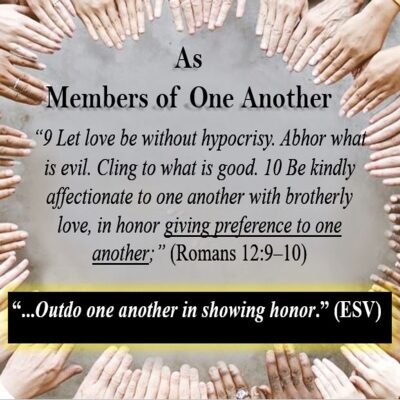
“9 Let love be without hypocrisy. Abhor what is evil. Cling to what is good. 10 Be kindly affectionate to one another with brotherly love, in honor giving preference to one another;” (Romans 12:9–10). There are many scriptures that speak to the subject of honor. In the ten commandments God gave to Israel, He commanded, “Honor your father and your mother, that your days may be long upon the land which the Lord your God is giving you.” (Exo. 20:12), Paul wrote, “Therefore if anyone cleanses himself from the latter, he will be a vessel for honor, sanctified and useful for the Master, prepared for every good work.” (2 Tim. 2:1). To honor as define by Thayer’s means, “a valuing by which the price is fixed; hence, the price itself: of the price paid or received for a person or thing bought or sold”…

In this lesson Paul instructs men and women in the church in acts of prayer, and professing godliness. Different roles for men and women.
The picture that Paul is giving us as a faith foundation is for Men: Show holiness, dignity, and godliness by having sincere hearts, praying in every place, free from anger and arguing. Women: Show holiness, dignity, and godliness by not drawing attention to your clothing but to your good works in the Lord.
Be different and show God to the world by your conduct.

Since the time when our great and amazing Creator made His beloved man (Gen. 1:27), and sin entered (Gen. 3) and the Lord drove man out of the garden (Gen. 3:24) Man has not been able to be with God, even the priests could not enter the house of the Lord, because the glory of the Lord had filled the Lord’s house” (2 Chronicles 7:2). Yet God through this great mercy has established a way for every man to one day stand again with Him in that Heaven for which we all hope for… and our hope is a Living Hope…
Living Hope 1 Peter 1:3 Paul says plainly Jesus our hope 1Tim. 1:1 “…the Lord Jesus Christ, our hope…”, “looking for the blessed hope and the appearing of the glory of our great God and Savior, Christ Jesus” Titus 2:13. “11 For the grace of God that brings salvation has appeared to all men, 12 teaching us that, denying ungodliness and worldly lusts, we should live soberly, righteously, and godly in the present age, 13 looking for the blessed hope and glorious appearing of our great God and Savior Jesus Christ, 14 who gave Himself for us, that He might redeem us from every lawless deed and purify for Himself His own special people, zealous for good works.” Titus 2:11-14).
Why is it a living hope? Because Our hope is in a risen Savior (John 11:25; John 2:22; Luke 24:6…
Paul says, “Therefore I [a]exhort first of all that supplications, prayers, intercessions, and giving of thanks be made for all men,” (1 Tim. 2:1).
First Of All Pray – (1 Tim. 2:1; 1 Tim. 1; John 17:20; 1 Pet. 2:5; Matt. 5:43-44). When you open the picture book of the Church—one image you see is a people of prayer. Consider Jesus He is the High Priest over the house of God—the church (Heb. 10:21). Jesus prays for all people as He said, “I do not pray for these alone, but also for those who [b]will believe in Me through their word” (John 17:20). Peter describes the church as, “…living stones, are being built up a spiritual house, a holy priesthood, to offer up spiritual sacrifices acceptable to God through Jesus Christ” (1 Pet. 2:5). Therefore, as Jesus prayed for all – we also should do.
Too often saints live limited and self-centered prayer lives: Prayer “bless this food to my body”, “Now I lay me down to sleep”, “Lord I need”… Prayer only when facing sickness or hard times. This of course is good—unless it’s the only times you pray. Rather Paul mentions four types of prayer that must be offered up for all people and all the time. A solid prayer life has many benefits which we’ll mention later in this lesson. Prayer isn’t always easy. You remember Jesus giving a difficult command concerning prayer: Love and “pray for those who spitefully use you and persecute you” (Matt. 5:43-44).
No one is to be excluded, the people of God are people who pray for everyone, even their enemies…

“10 But I rejoiced in the Lord greatly that now at last your[a] care for me has flourished again; though you surely did care, but you lacked opportunity. 11 Not that I speak in regard to need, for I have learned in whatever state I am, to be content: 12 I know how to [b]be abased, and I know how to [c]abound. Everywhere and in all things I have learned both to be full and to be hungry, both to abound and to suffer need. 13 I can do all things through [d]Christ who strengthens me” (Philippians 4:10-13).
Paul is stating that he is spiritually able and strong because of the great power (evdunamonti) that he has received from Him,
Christ Jesus our Lord…
From Sin to Grace: “12 And I thank Christ Jesus our Lord who has enabled me, because He counted me faithful, putting me into the ministry, 13 although I was formerly a blasphemer, a persecutor, and an [a]insolent man; but I obtained mercy because I did it ignorantly in unbelief. 14 And the grace of our Lord was exceedingly abundant, with faith and love which are in Christ Jesus.” (1 Tim. 1:12–14)
Without question Paul, like myself, is underserving because of his sins. Note beginning at verse 13 how Paul pours out his soul concerning his sins against God. We should all be able to relate to some of these: He was a blasphemer, persecutor, and insolent man. And if we can’t relate to theses sins what about Romans 1 beginning at verse 28…
Praise be to God and our Lord Jesus Christ that the power of the gospel can turn even me a sinner—into a servant in spite of my all my sins.