SPIRITUAL OR CARNAL
the Old Testament was writting for our learning that we through the patience and comfort of the Scriptures might have hope (Rom. 15:4). Certainly Joshua was a leader who had hope in the Lord and he trusted in the great commander who went before him and the conquest was successfull to the point of were the people could dwell in that land of milk and honey, and they had to continue to fight, to resist the temptations that were before them and the nations that were driven out.
So in Joshua 24:14-15 we read, “14 “Now therefore, fear the Lord, serve Him in sincerity and in truth, and put away the gods which your fathers served on the other side of the River and in Egypt. Serve the Lord! 15 And if it seems evil to you to serve the Lord, choose for yourselves this day whom you will serve, whether the gods which your fathers served that were on the other side of the River, or the gods of the Amorites, in whose land you dwell. But as for me and my house, we will serve the Lord.”
As we’ve read afore, Joshua made it clear, there is a choice to make, and we can express that simple choice, certainly we must say it is a black and white choice, whether of not we will serve the true and living God or whether the god of this world.
In this lesson we are going to express the choice in a little different manor. We’re going to ask each of us to consider this, for we have a choice that each of us have to make. Will we be spritual or will we be carnal?
IDENTITY OF THE CHURCH – PART 5 YOU ARE HEIRS
You are Heirs
Because we have been redeemed by the applied blood of Christ, our sin debt has been paid, and being restored we are now heirs – God’s inheritance. At verse 11 we read…
“In Him also we have obtained an inheritance, being predestined according to the purpose of Him who works all things according to the counsel of His will,” (Eph. 1:11)
The first point that needs to be explored is this.
We must not make the mistake of connecting “obtaining an inheritance” to the promise of a home in heaven Jesus made us (John 14:1-3, 6).
The “inheritance” means you are now one of the people of God, God’s child, not the home in heaven, but that God is now your Father, and you are His precious child.
Consider the promises of God to His chosen people Israel…
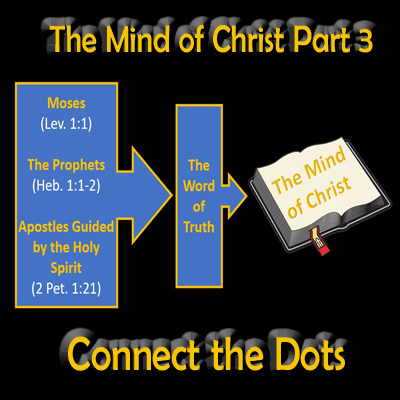
THE MIND OF CHRIST – CONNECT THE DOTS
We are continuing our evening series on the mind of Christ
Our goal is to know more about Jesus
To learn from His thoughts to try as best we can to make them our thoughts
To see how Jesus handles day to day dealings with people who both love Him and even those who hated Him
Today, turn with me to the book of John, and chapter John 6:59-69…
IDENTITY OF THE CHURCH – YOU ARE REDEEMED PART 4
In this our 4th lesson we’ll learn part of what all this means as we study what it means to be redeemed. We begin at verse 7 of chapter one which reads:
“In Him we have redemption through His blood, the forgiveness of sins, according to the riches of His grace” (Ephesians 11:7)
Our redemption was made possible only because of God’s great love. Redemption defined: (ἀπολυτρόω signifying a. to redeem one by paying the price). The Oxford Dictionary has, “the action of saving or being saved from sin, error, or evil. God’s plans for the redemption of his world”.
Only through Christ do we have redemption.
As Paul said, redeemed through His blood
John wrote of Jesus saying, “…You were slain, And have redeemed us to God by Your blood Out of every tribe and tongue and people and nation” (Rev. 5:9)
We have been made free, the debt we could not pay for our sin was paid for by Jesus’ own blood…
IDENTITY OF THE CHURCH – YOU ARE PREDESTINED TO ADAOPTION PART 3
These are the words of the Apostle Paul to the saints in Ephesus.
“5 having predestined us to adoption as sons by Jesus Christ to Himself, according to the good pleasure of His will, 6 to the praise of the glory of His grace, by which He [a]made us accepted in the Beloved.” (Ephesians 1:5-6)
Before the foundation of the world, God, in His infinite mind, planned for the church to exist. The church was predestined to be occupied by individuals who will obey the Gospel. In the physical sense it would be like a man designing plans for a “building” with intention of filling it for some specific purpose. The building by itself is just a building – until occupied. What is inside defines what name is on the building. Let me explain:
In the 1900’s a man named William Isaly designed a building and had it built in Mansfield, Ohio
He then filled the building with Ice-cream products and Isley’s was born.
Years passed and Isley’s went out of business and the same building became Austin’s Outlet Store.
Again Mr. Austin passed and the building was purchased by Barberton Check Cashing.
Again, that business closed and the building became Redline Train and Hobbies. . .
Then after they closed up, Billy Bob bought it. . .
Finally, Billy Bob retired, and the Fellowship Community church purchased the building.
God is the original designer for His church, and had a purpose for the building before the building existed and listen, God’s building the church, is eternal, for it exists now, and is the only thing that will be delivered up to Heaven to the Father when the end of the physical comes as Paul wrote, “Then comes the end, when He delivers the kingdom to God the Father, when He puts an end to all rule and all authority and power.” (1 Corinthians 15:24). God the Father is eternal and He therefore, never dies as we read what John wrote, “The four living creatures, each having six wings, were full of eyes around and within. And they do not rest day or night, saying: “Holy, holy, holy, Lord God Almighty, Who was and is and is to come!” (Revelation 4:8).
Who was and is and is to come means He is eternal…
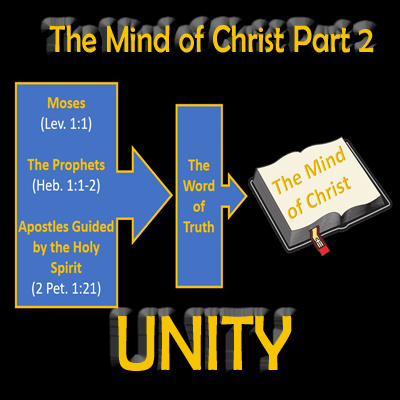
THE MIND OF CHRIST PART 2 “UNITY”
To begin our study we will consider some of the attitudes which are necessary for unity. Therefore, as we seek to know the mind of Christ, let’s consider attitudes Necessary for Unity.
We will begin with Lowliness of mind, then finnish up with unselfishness, …
“YOU ARE THE CHOSEN”
The title of our lesson today is “You are the Chosen”. We learned in our first lesson that our LORD called us saints, not because we performed some miracle, or because we are especially talented, not because of anything to “deserve” sainthood, but because we obeyed the gospel of Jesus Christ, and were baptized into His body, the church.
Let’s begin our study in the 3rd verse, “Blessed be the God and Father of our Lord Jesus Christ, who has blessed us with every spiritual blessing in the heavenly places in Christ,” (Eph. 1:3)…
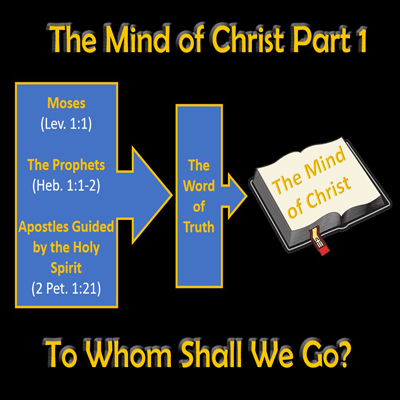
TO WHOM SHALL WE GO
In seeking to know the mind of Christ, we have begun a journey! Together we will travel through the gospels learning along the way what we can about our Lord, and Savior. About His humanity, his interaction with man, how Jesus handled the approaches of sinners, and how He used scripture to answer their often-foolish questions. How, many with good and honest hearts came to Jesus for wisdom, for healing, for comfort and chose to become His disciples.
On this journey, we will learn of His compassion, His power, His love!
To know the mind of God, means that we have received the message directly from God, and that message came into the world, out of the love of God, to be our redemption, Savior and Friend.
What a better place to begin, than in the gospel account of John…
YOU ARE SAINTS
Webster defines the word “identity” simply as, “the distinguishing character or personality of an individual”. We all have an identity such that when someone talks about us, the hearer quickly recognizes the person being spoken of. You remember him, he’s 71 years old, he preaches the gospel at the Columbus Street Church of Christ, his wife’s name is Sharon, and they have three children. . .
We’ve all heard of the “Witness Protection” program. Where a person testifies against another in a court of law and the authorities give them a new “Identity”. New name, new SS number, and often times even a new background, so that for all intense and purpose the “Old Person”, no longer exists.
Much like what happens when one obeys the gospel. “3 Or do you not know that as many of us as were baptized into Christ Jesus were baptized into His death? 4 Therefore we were buried with Him through baptism into death, that just as Christ was raised from the dead by the glory of the Father, even so we also should walk in newness of life.” (Rom. 6:3-4)
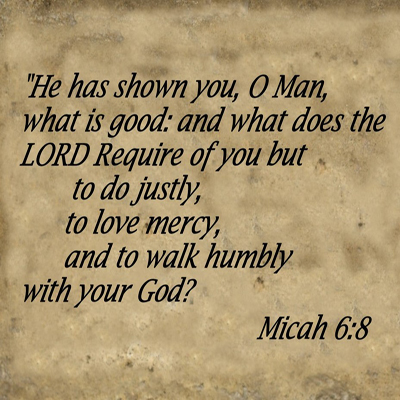
WHAT DOES THE LORD REQUIRE OF YOU?
“He has shown you, O man, what is good; And what does the Lord require of you but to do justly, to love mercy, and to walk humbly with your God?” (Micah 6:8)
The question asked by the prophet Micah so many years ago suggests that the LORD requires certain thins of His people.
We who love the word of the Lord, we who love Him because He first loved us have the desire to please Him.
We want to do all that He commands us to do.
This verse may contain the most comprehensive and all-embracing statements from the old testament, asking and then answering “What does the LORD require of you?”
Join me as we pull thoughts from the mind of God through the scriptures on this subject.