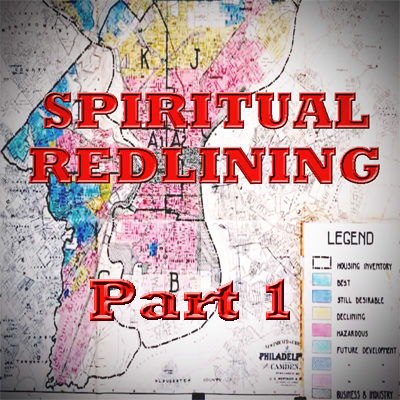
Jesus gave command, “Go [a]therefore and make disciples of all the nations, baptizing them in the name of the Father and of the Son and of the Holy Spirit” (Matt. 28:19), and go we must. But for some making disciples can become a stone of offense.
There is a term, “Redlining” was coined in the late 1960s by John McKnight, a sociologist and community activist referred to a practice that began with the National Housing Act of 1934, which established the Federal Housing Administration (FHA). Plainly speaking is was a practice of denying, or charging more for, services such as banking, insurance, access to health care, or even supermarkets, or denying jobs to residents in particular geographic areas. The use of blacklists – used by redliners to keep track of groups, areas, and people that the discriminating party felt should be denied business or aid or other support. It refers to the practice of marking a red line on a map to delineate the area where banks would not invest; later the term was applied to discrimination against a particular group of people Blacks, Jews, Indian, Latinos, Asians etc.
For some Christians, this is a spiritual practice. Not in the sense that Christians draw redlines on maps to delineate areas where they won’t evangelize. But because they “feel” like they can’t talk to someone based on different backgrounds, different cultures, different education, even different skin color can for some be intimidating. Some examples of the you might relate to. You’re a Christian and you have an appointment with your doctor. You feel like talking to him or her about Jesus but you don’t. Why? Because you also feel intimidated, like they are “higher” up the scale than you because of their title, “Dr.”. Another example, you’re out doing door-to-door work and you come across a man who intimidates you because of his apparel and size. That is he is a very large man wearing black leather, tattoos all over, scraggly beard, and a chained wallet, i.e., a motorcycle gang look. So, you again feel intimidated and you pass him by and go to the next house. Many examples like this can be sighted including ones perceived attitude, skin color, and ethnicity.
For most Christians, this can happen without malice or intent. Many are just intimidated, because they don’t feel like they can reach the person, the feel inadequate for the task. This is true in many areas of life, work, play, and school. But when we, as Christians, don’t speak to others of Jesus because of this, we are sinning, and we are forgetting the command of Christ, and the power of God. Fact is, if you are a Christian, you know what must be done to be reconciled to God, so just say that, and remember that if you don’t you are guilty of allowing your shame to hinder another. Paul said, “For I am not ashamed of the gospel [a]of Christ, for it is the power of God to salvation for everyone who believes, for the Jew first and also for the Greek” (Rom. 1:16).
Note that this is a two part lesson, here we will open our eyes to the practice of redlining others because we don’t feel capable, and in the second lesson we’ll discuss the opposite where others redline Christians because of their beliefs.
We are continuing from our last lesson with some things that Jesus will do on the Great Day of the Lord. We know that • Jesus Will Come Again • Bring Those Which Sleep in Him • Raise the Dead • Judge All • Put Down His Rule and • Deliver Up the Kingdom. Knowing these things brings Christians great comfort.
But there are some in the religious world who teach Jesus will sit on the throne of David literally, which cannot happen. In most of this lesson we’ll search through scripture and reveal truth on this subject so that we will know the truth, and the truth will set us free from all the false doctrines of men.

Paul wrote, “Therefore, my beloved brethren, be steadfast, immovable, always abounding in the work of the Lord, knowing that your labor is not in vain in the Lord” (1Cor. 15:58). Fact is that we must daily be working in the vineyard of the Lord. Seeking to save lost souls, and teaching God’s word not just to those who have not learned but also to every member of the body.
Jesus’ work on earth is done and that puts the responsibility to teach God’s word to all who will listen. Teaching truth about Jesus, salvation and worship. Doctrine found in the New Testament is the only pattern we have from God on any subject regarding the church and church membership. Many teach false doctrine and the Lord’s people must be teaching truth. Many teach Jesus will return and set up a literal kingdom, He will not. Many teach that one only needs to be “good” to enter the kingdom of heaven, that is just not so. Some teach that God will save some to heaven and some one a “new earth”, and we know that is a false teaching.
In these two lessons we will cover some things the church must teach so that false ideas can be removed and the truth will prevail. What will really happen the next time Jesus appears? Let’s see. . .

Cost of Discipleship Too High – Matt. 8:18-22, 19:22
(1) (vs.18-20), “18 And when Jesus saw great multitudes about Him, He gave a command to depart to the other side. 19 Then a certain scribe came and said to Him, “Teacher, I will follow You wherever You go.” 20 And Jesus said to him, “Foxes have holes and birds of the air have nests, but the Son of Man has nowhere to lay His head.”
(2) (vs.21-22) “Then another of His disciples said to Him, “Lord, let me first go and bury my father.” 22 But Jesus said to him, “Follow Me, and let the dead bury their own dead.””
Many people rejected discipleship because of the cost was more than they were willing to pay.
(3) Like the rich young ruler we studied in the first lesson—who also “went away sorrowful, for he had great possessions” (Matt. 19:22)
All these are exact opposites of the men we studied in Matthew 13 who counted the kingdom of heaven worth more than all they possessed.
Good news is that there are enough examples of men and women willing to pay whatever the cost to gain eternal life—that by them we are encouraged and strengthened. . .
Then in this lesson I like to focus more on examples of people willing to pay any price, people who thought nothing of giving all they possessed to have eternal life—to have Jesus as Lord.
Cost of Discipleship Is Worth It All? We’ll begin with Paul who was willing to pay all…

Have you ever thought about the direct connection between how much time and effort you put into something and its value?
A brother in Christ, and my best friend Jack owned a Datsun 240 Z. Jack spent a lot of time, a lot of money, and a great deal of effort in keeping that car pristine. Even to the point of stripping the car down to only the body, and having that dipped in acid to remove the paint, then having it repainted so that it looked like new again. I am talking thousands of hours, thousands of dollars, and all to restore a car that he eventually sold because it started to rust again. My beloved brother and friend Jack is gone to his reward now, and I am certain that old car is still here.
In the parable from Matthew 14:44-50 Jesus is really talking about the value men placed on earthly temporary things compared to the value they placed on the spiritual eternal things. For every one of us, this will eventually come down to one question. Do you find Christ and His kingdom to be a priceless treasure to your soul above all? Please study this with me as we expound on what and where our treasure is. . .
In Mark 12:28-34 A scribe asked Jesus, “Which is the first commandment of all?” (v.28). Jesus answered, “The first of all the commandments is: ‘Hear, O Israel, the Lord our God, the Lord is one. 30 And you shall love the Lord your God with all your heart, with all your soul, with all your mind, and with all your strength.’ This is the first commandment” (vs.29-30).
What is of interest and the reason for this lesson is the word “first” which both the scribe and Jesus used (v.28, and v.29) and the word “One” that referenced the Lord (vs.29, 32). As for “first”, the NKJV Bible if you look closely, you’ll see the [superscript j and k] next to the word “first” in both verses. • The footnote attributes the word first to foremost • The actual Greek word is [Πρώτη] which carries the meaning first in rank, influence, honor; chief; principal” [Thayer’s]. • Note how most of the other translations translate “first”: NIV; NLT; ESV; BSB; AB; CSB; HCTB; CEV; GNT; ISV; NET Bible all translated it as; “The most important one”
After hearing the Lord’s answer, “the scribe said to Him, Well said, Teacher. You have spoken the truth, for there is one God, and there is no other but He.to the question” (v.28). The idea that there is only One God, and that the most important “first” command is to love Him with every cell in our body caused me to think of what it really means to make God first, most important in every aspect of our lives, in everything that we say, every decision and everything we do. God just must be our everything.
This all caused me to remember the record of a woman who was commanded to make a cake for the servant of God first, and then for herself and her son. Open your Bibles and turn to 1 Kings chapter 17 and let’s study from verse 8. . .
As you heard read Paul wrote, “3 For every high priest is appointed to offer both gifts and sacrifices. Therefore it is necessary that this One also have something to offer. 4 For if He were on earth, He would not be a priest, since there are priests who offer the gifts according to the law; 5who serve the copy and shadow of the heavenly things, as Moses was divinely instructed when he was about to make the tabernacle. For He said, “See that you make all things according to the pattern shown you on the mountain.” 6 But now He has obtained a more excellent ministry, inasmuch as He is also Mediator of a better covenant, which was established on better promises” (Hebrews 8:3-6).
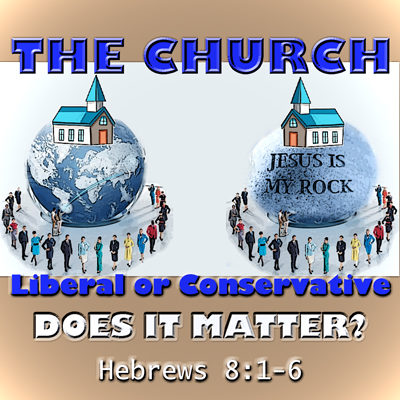
The one true church belongs to Jesus, He alone is the Head—we are His servants—and whatever we do we do in the name of the Lord. I would imagine that most of us have heard the terms “Liberal and Conservative” concerning the church. What is alarming to me—is that most people in the church don’t understand what the difference is, and not understanding this leads to false assumptions about the church and eventually to false teaching and apostacy.
Join with me as we study from the scriptures, and seek an answer to this important question about the Lord’s church. Does it matter if it is liberal or concervative?
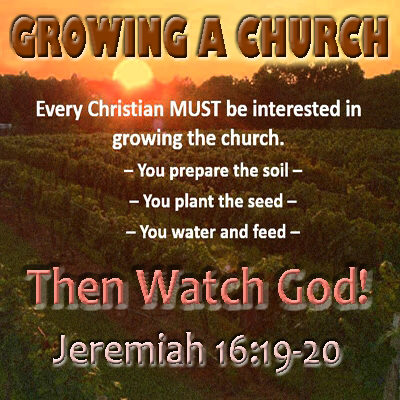
Every Christian must be interested in growing the church. We all know how to grow flowers or corn. You prepare the soil, you plant the seed, you water and feed. In the very exact way the Church of Christ grows. You prepare the soil: Which is a man’s heart (Proverbs 2:1-5) “My son, if you receive my words, And treasure my commands within you, So that you incline your ear to wisdom, And apply your heart to understanding; Yes, if you cry out for discernment, And lift up your voice for understanding, If you seek her as silver, And search for her as for hidden treasures; Then you will understand the fear of the Lord, And find the knowledge of God.” You plant the seed: Which is the Word of God (Luke 8:11). One waters and one feeds, which is our work as Christians, but God makes it grow (1Cor 3:6&7).
THE RESULT: Acts 2:41 “Then those who gladly received his word were baptized; and that day about three thousand souls were added to them.” We will not grow unless we (1) believe we will (2) strive to be strong in proclaiming His word, then we will grow. Acts 2:47 “praising God and having favor with all the people. And the Lord added to the church daily those who were being saved.” We want that church to be strong through edification, Bible study, Worship, Challenging one another, making ourselves ready to answer any question from others (1Peter 3:15).
Paul says, “These things I write to you, though I hope to come to you shortly; but if I am delayed, I write so that you may know how you ought to conduct yourself in the house of God, which is the church of the living God, the pillar and ground of the truth” (1 Timothy 3:14-15).
The church established in 32 A.D., in the city of Jerusalem and built according to the commandments of Jesus Christ who, purchased it with His own blood (Acts 20:28). His church belongs to Him and He alone is the Ruler, King, and Lord. We’ve already searched the scriptures and found that there is only one possible way into His church, which is His body (Col. 18:18, 24), and that is noted in Acts chapter 2 at verses 38, 41, and 47. Every member of the church that Christ built was baptized “into” Christ’s body, (Acts 2:38; Gal. 3:27).
Now those who are members of the body of Christ did continue having fellowship one another as Luke records, “And they continued steadfastly in the apostles’ [n]doctrine and fellowship, in the breaking of bread, and in prayers. ” (Acts 2:42). I emphasized the word fellowship because that is what this lesson is about. In this lesson we will examine Fellowship in the New Testament Church. The fellowship of the Bible is a sharing and a connection with the gospel. The fellowship of the Bible brings us into a partnership and binds Christians together with the Father the Son and the Holy Spirit. Walking in the light, i.e., devoted to, following the apostles’ teaching, living and obeying the gospel together as one body in Christ Jesus our Lord (1 John 1:3-7; Phil. 1:5).
Please listen in with an open Bible and an open heart as we look at fellowship Christians have with one another.
As we studied in our last lesson, as human beings, we tend to forget things. Details become lost as the feelings and impact of past events fade. Remember the Challenger, the events of 911, the U.S. embassy bombing in Beirut, Lebanon, what year did that happen, how many Americans died?
Moses wrote, “6 “And these words which I command you today shall be in your heart. 7 You shall teach them diligently to your children, and shall talk of them when you sit in your house, when you walk by the way, when you lie down, and when you rise up. 8 You shall bind them as a sign on your hand, and they shall be as frontlets between your eyes. 9 You shall write them on the doorposts of your house and on your gates” (Deut. 6:6-9). That was because it is so easy to forget history, what God did for the Jews, what God did for the world. I think that few people alive today don’t know the words, “For God so loved the world that He gave His only begotten Son, that whoever believes in Him should not perish but have everlasting life” (John 3:16). There indeed may be few who don’t remember, but the tragedy is that to a greater extent there are fewer who remember what Jesus did for them during the last three years of His life on the earth. That is why we must also teach about Jesus not just to our own children but to everyone we come in contact with. Peter wrote, “But sanctify the Lord God in your hearts, and always be ready to give a defense to everyone who asks you a reason for the hope that is in you, with meekness and fear;” (1 Peter 3:15), and Paul, “And you, fathers, do not provoke your children to wrath, but bring them up in the training and admonition of the Lord.” (Ephesians 6:4).
We must regularly study our Bibles as Paul instructed Timothy, “Be diligent to present yourself approved to God, a worker who does not need to be ashamed, rightly dividing the word of truth” (2 Tim. 3:15). Remember the virgin birth (Isa. 7:14; Matt. 1:25), remember the miracles, “Water to Wine” John 2:10, “Raising Lazarus from the dead” John 11:1-45, “Walking on Water” Matt. 4:22-33, or “Feeding the 5,000” 14:13-21). And lest we forget the resurrection of our Lord from the dead, Acts 10:40; Matthew 28:5-6 or why Jesus died in the first place, “But God demonstrates His own love toward us, in that while we were still sinners, Christ died for us” (Romans 5:8). We must not forget that Jesus will return to take the saved, that is the church up to heaven to be forevermore with God (John 14:1-6; 1 Cor. 15:4).