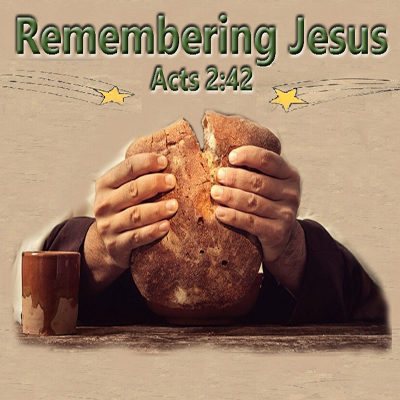
Luke recorded, “And they continued steadfastly in the apostles’ [a]doctrine and fellowship, in the breaking of bread, and in prayers” (Acts 2:42). Our lesson today is again from Acts 2:and verse 42: It is titled, “Remembering Jesus” and comes via the words “in the breaking of bread”.
Why is the Lord’s Supper important? Why be devoted to the breaking of bread? When we search the scriptures concerning the taking of the cup, and the bread we will find significant importance to the church, and the weekly practice of the Lord’s Supper. Let’s consider why the Lord’s Supper is important enough that it was Commanded? First because we must . . .Remember Jesus – 1 Cor. 11:24-25; 2 Tim. 3:16; Matt. 1:23; Phil. 2:8; 1 Cor. 15:20.
One such reason is because Most People Have Poor Memories. That’s right—we tend to forget quickly—even things we think we’ll never forget. What is the difference between Memorial Day and Veteran’s Day? Who invoked the Emancipation Proclamation? Who was it that introduced the concept of the “Sinner’s Prayer”, and is that found anywhere in the Bible? Many of these events caused tremendous personal loss, heart stopping, surrealistic pain, on the day they occurred—but a few years later we no longer feel the affect. Why? All because we do have short memories. But – we practice the Lord’s Supper so that we will always remember Jesus. That is why in regard to the practice of the Lord’s Supper, Paul twice quoted Jesus. . .to “do this in remembrance of me” (1 Cor. 11:24, 25).
Paul wrote, “And without controversy great is the mystery of godliness: God was manifested in the flesh, justified in the Spirit, seen by angels, preached among the Gentiles, believed on in the world, received up in glory” (1 Tim. 3:16). We begin our study by defining the phrase “without controversy”. What does it mean? It means there is no, nor can there be any doubt. In this context it means no one should have had any doubt that Jesus was the Christ. Why is this “without controversy”? First, because there where 10’s of 1,000’s of witnesses that saw Jesus alive, i.e., he was (5,000 John 6:1-14), (4,000 Matthew 15:32-39), (Great Multitude Luke 6:17-19), (Witnesses 1 Corinthians 15:3-8). Then there are the Old Testament prophecies Jesus fulfilled concerning the Messiah—it couldn’t be clearer. Jesus said, “17 “Do not think that I came to destroy the Law or the Prophets. I did not come to destroy but to fulfill. 18 For assuredly, I say to you, till heaven and earth pass away, one [a]jot or one [b]tittle will by no means pass from the law till all is fulfilled.” (Matthew 5:17-18).
Jesus Really Did Just That: “44 Then He said to them, “These are the words which I spoke to you while I was still with you, that all things must be fulfilled which were written in the Law of Moses and the Prophets and the Psalms concerning Me.” 45 And He opened their understanding, that they might comprehend the Scriptures. 46 Then He said to them, “Thus it is written, [a]and thus it was necessary for the Christ to suffer and to rise from the dead the third day, 47 and that repentance and remission of sins should be preached in His name to all nations, beginning at Jerusalem. 48 And you are witnesses of these things.” (Luke 24:44-48). It is “without controversy” because, “There are three hundred and thirty-two distinct prophesies in the Old Testament which have been fulfilled in Christ.” [Joseph P. Free, Archaeology and Bible History, 284].
Secondly, also, “without controversy” because even historians like Titus Flavius Josephus who was a first-century Jewish historian, military general, and ambassador for Rome. Josephus was a highly educated aristocrat, born into a wealthy family with strong ties to the Jewish priesthood. Of Jesus he recorded “Now there was about this time Jesus, a wise man, if it be lawful to call him a man; for he was a doer of wonderful works, a teacher of such men as received the truth with pleasure. He drew over to him both many of the Jews and many of the Gentiles. He was [the] Christ. and when Pilate, at the suggestion of the principal men amongst us, had condemned him to the cross, those that loved him at the first did not forsake him; for he appeared to them alive again the third day; as the divine prophets had foretold these and ten thousand other wonderful things concerning him. And the tribe of Christians, so named from him, are not extinct at this day. ”
What is amazing? That so many today still refuse to believe the plain and substantiated truth that Jesus was proven historically, biblically to be the Messiah, the Christ, the Son of the living God. That is without controversy mind-boggling.
In Acts 2 at verse 42 Luke records how the early church lived out their new faith. I like the NASB wording, “They were continually devoting themselves to the apostles’ teaching and to fellowship, to the breaking of bread and to prayer” (Acts 2:24 NASB). The term “continued steadfastly” from the Greek word PROS-KAR-TER-EH-O as meaning “to give constant attention : to be devoted or constant to one” They were addicted or devoted to: 1. The Apostles Teaching / Doctrine, 2. To Fellowship, 3. To the Breading of Bread – the Lord’s Supper and 4. to Prayer
Being devoted to the apostles teaching means their focus comes from only one place—the word of God, as Paul wrote, “Faith comes by hearing and hearing by the word of God” (Rom. 10:17).
That they were continually showing devotion to the Word brings a necessary conclusion: That was devoting time and energy to those things. To them it wasn’t, “well, if we must”, nor was it, “I have other important things to do”, or “I must balance my time and energy between the world and God”. “They were continually devoting themselves. . .
We must be honest with ourselves – left to our own way of thinking we’ll end up utterly lost, and without hope.
What changed those saints from walking in the futility of their mind? • What cured their ignorance, what took away the blindness of their heart? • What raised them from having no hope—to having living with all hope?
The answer is “20 But you have not so learned Christ, 21 if indeed you have heard Him and have been taught by Him, as the truth is in Jesus: 22 that you put off, concerning your former conduct, the old man which grows corrupt according to the deceitful lusts, 23 and be renewed in the spirit of your mind, 24 and that you put on the new man which was created according to God, in true righteousness and holiness” (Eph. 4:20-24).
But you have not so learned – – –
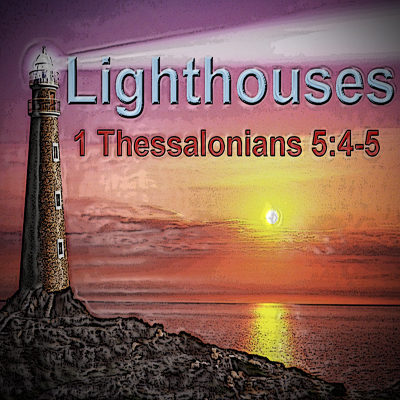
Lighthouses, my mother loved them, so one day I was looking at how they worked. And I realized there are some parallels we can draw from them in our own lives. D.L. Moody once ended his sermon by appealing to his audience saying brothers the Master will take care of the great lighthouse, let us keep our lower lights burning. Among those in attendance was Philip Biss who was a very well known hymn writer. After hearing this message he penned the words, “Let the Lower Lights Be Burning” to music from this most striking story and it ended up becoming one of his most powerful hymns.
Where are lighthouses? Of course they are along the shore. Ask yourself, if you found a lighthouse in the middle of Kansas is it doing it’s job like the one’s along the shore? When is a lighthouse needed the most? Is it needed during the day? No, it is needed in the dark. In this lesson we will talk about light and darkness as they are portrayed in the bible. You are not in darkness, you are in the light (1 Thessalonians 5:4-5).
Addicted is a word defined by Webster as, [strongly inclined to do, use, or indulge in something repeatedly] . We can be addicted to bad things: Alcohol, Drugs, Porn, Gambling, and Cigarettes, etc.
We can be addicted to good things: Gardening, Reading, Woodworking, scholastic endeavors, or Modeling, etc. but the best thing anyone can be addicted to is the study and application of God’s word.
On the day of Pentecost that is what happened to at lest 3,000 souls. Scripture tells us that after the gospel concerning Jesus was preached for the first time by Peter (Acts 2:1-36) that those who heard and were convicted asked, “Peter and the rest of the apostles, “Men and brethren, what shall we do?”, (v.37). Peter’s answer, “Repent, and let every one of you be baptized in the name of Jesus Christ for the [k]remission of sins; and you shall receive the gift of the Holy Spirit” (v.38), “Then those who [m]gladly received his word were baptized; and that day about three thousand souls were added to them” (v.41). After which we read, “And they continued steadfastly in the apostles’ [n]doctrine and fellowship, in the breaking of bread, and in prayers” (Acts 2:42).
That term, “steadfastly”, is a compound word [προσκαρτερέω], pronounced “PROS-KAR-TER-EH-O”. PROS means “towards”, and KARTEREHO, means “to give constant attention to a thing : to adhere to one, be his adherent; to be devoted or constant to one”. That is to say these new converts were addicted to the word, “apostle’s doctrine” which includes, but is not limited to (1 Cor. 14:37), fellowship, breaking of bread, and prayers.
These were devoted, addicted to spiritual things. In this lesson we will discuss some of these. Please listen on and if you have questions don’t hesitate to call me by the number listed on the contact tab.
he Mentality of a Living Stone
This lesson is titled “Mentality of A Living Stone”, and from Peter’s first letter where he wrote, “you also, as living stones, are being built up a spiritual house, a holy priesthood, to offer up spiritual sacrifices acceptable to God through Jesus Christ” (1Peter 2:5). Given our recent focus on the church I’d like to continue on with that theme specifically addressing our individual roles as members of the Lord’s body. In this particular text from Romans 1 Paul lays out a pattern that starts with the Lord Jesus Christ. The book of Romans is said to be the most significant and comprehensive of the apostles’ writings explaining the message of the gospel and it’s practical application in our lives individually and as members of the local body. The apostle Paul being our example he certainly has credentials. He is after all, the apostle to the gentiles, he established multiple churches and is responsible for penning nearly half of the New Testament.
I’d like to lay out three principles, or mindsets we ought to have if we are going to contribute to the growth of the church.
One – Paul Referred to Himself as a Bondservant – Romans 1:1. We are exclusively His!
Two – Love for One Another, the Church and Every Soul – Romans 1:8-14 The love of God compels us (2 Cor. 5:14)!
Three – The Gospel: Learn it, Live it, Preach it – Romans 1:16-17. We preach Christ, and if we preach Christ then we are living Christ, and we are impacting our world.
Please listen on and hear the explanation for each one of these points, and may God be glorified in this message and in you.
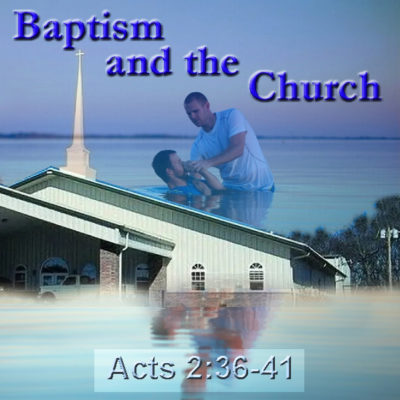
In this lesson we begin with the message titled Baptism and The Church … “37 Now when they heard this, they were cut to the heart, and said to Peter and the rest of the apostles, “Men and brethren, what shall we do?” 38 Then Peter said to them, “Repent, and let every one of you be baptized in the name of Jesus Christ for the [a]remission of sins; and you shall receive the gift of the Holy Spirit” (Acts 2:37-38). I often find it beyond the realm of explanation that at just the mention of the word “baptism” people are sent into a myriad of red flag responses. In Acts 2 verses 37 through 38 which you just read, and as you see in your own bibles, the text is simple, straightforward and easy to understand. Yet, to the many denominations in our world today, baptism is extremely contentious, controversial and even a combative subject. Honestly, I don’t understand why. When you read from Acts 2 and verse 38 it seems so simple, and is in harmony with every other scripture concerning baptism. Yet many, because of teachers that refuse to allow scripture to be right—have confused many by their opposing doctrine and contradictions.
But if you contend, as so many do, about the purpose of baptism—then you also must argue against many other simple verses on the subject—and prove they don’t mean what they clearly say. Many have confused the majority with their teaching hewing for, “themselves—broken cisterns that can hold no water” as Israel did in Jerusalem in the days of Jeremiah when God brought charges against the people for forsaking Him (Jer. 2:13). What I hope to accomplish in this lesson is to simplify. . .What must precede baptism, hopefully—stripping away any misunderstanding for the reason, and purpose of baptism.
There is a game that children played, at least when I was younger, called hide and seek. The object was for one person to cover their eyes and count to 100 while everyone else sought a hiding place, then the one counting would shout, ready or not here I come, and begin to search out the other friends one by one. Everyone who has not found a hiding place—they are immediately counted out. I say this to illustrate the fact that Jesus is coming, He will judge, and that will happen whether we as an individual, or we as a church are ready or not. Paul wrote, “No one can hide from God. His eyes see everything we do. We must give an answer to God for what we have done” (Heb. 4:13). When Jesus comes we know this, there will be no place to hide—so we better get it right. Jonah though he ran, he was found by God.
We don’t know when the Lord will come, but I can almost here Jesus “Ready or not, here I come”. In our lesson today—we will focus on just that—are we ready or not—or spiritually speaking when Jesus does come will we be found “Faithful or Not!”
What we must devote ourselves to is the work God ordained and nothing more so that, we will be as the church in Philadelphia? (Rev. 3:7-13). Will Jesus say, “and to the angel of the church in Bedford Ohio write, I know your works. See, I have set before you an open door, and no one can shut it; for you have a little strength, have kept My word, and have not denied My name. Because you have kept My command to persevere, I also will keep you from the hour of trial which shall come upon the whole world, to test those who dwell on the earth. He who overcomes, I will make him a pillar in the temple of My God, and he shall go out no more. I will write on him the name of My God and the name of the city of My God, the New Jerusalem, which comes down out of heaven from My God. And I will write on him My new name. I pray this is so.
When all is said and done, in the eyes of the Lord, will He find us, “Faithful or Not”? This question must be asked, and we must give an answer—good or bad—we must answer.
“And there is no creature hidden from His sight, but all things are naked and open to the eyes of Him to whom we must give account.” (Heb. 4:3). “Before I even speak a word, you know what I will say” (Psa. 139:4 CEV). “The eyes of the LORD are in every place, Keeping watch on the evil and the good” (Prov. 15:3), and finally, “For My eyes are on all their ways; they are not hidden from My face, nor is their iniquity hidden from My eyes” (Jer. 16:17). If the answer is yes—then we must just continue to do what we have been doing. If the answer is no—then we must come together and resolve what is lacking and eliminate everything that is in discord with God’s will for this church.
Let’s strive to be faithful in all things that the Lord our God commands us.
WHEN YOU LOVE THE LORD YOUR GOD WITH ALL YOUR HEAR, MIND AND SOUL KEEPING THE COMMANDS ARE – NOT BURDENSOME: Then—as for the rest Paul wrote, “For the commandments, “You shall not commit adultery,” “You shall not murder,” “You shall not steal,” [b]“You shall not bear false witness,” “You shall not covet,” and if there is any other commandment, are all summed up in this saying, namely, “You shall love your neighbor as yourself.” 10 Love does no harm to a neighbor; therefore love is the fulfillment of the law” – Romans 13:9-10.
IF I LOVE THE LORD MY GOD WITH ALL MY HEART-MIND AND SOUL—THESE ARE THINGS I DON’T RESTLE WITH—Not a burden
LOVING GOD IN THIS WAY MAKES THE DISCISION EASYER. . .
Listen—every time we struggle with our time—things we want to do—having friends over—should I leave them and come to worship.
Every time there is a temptation to stay home to watch a game – or just to relax.
Every time we struggle—should I go to the study—should I go to that gospel meeting—should I go to the fellowship meeting.
“The Church Must Have Purpose” The meaning behind the word purpose: It is “the reason for which something is done or created or the reason for which something exists. [Oxford Languages]” – Implies – conviction and force. Jesus speaking of His death, “Now My soul is troubled, and what shall I say? ‘Father, save Me from this hour’? But for this purpose I came to this hour” (John 12:27).
Our Purpose Must Not Be: To Please Men – “But as we have been approved by God to be entrusted with the gospel, even so we speak, not as pleasing men, but God who tests our hearts” (1 Thess. 2:4). There are many religious people in the world whose purpose is to be pleasing in the eyes of men—which opens the floodgate of error. One way this happens is when the church starts to accept Human Tradition. God’s purpose was for the church to assemble on the first day of the week—and to break bread, pray, sing songs, hymns and spiritual songs, and take up an offering are commands, not traditions. But Human tradition says you can assemble and serve the Lord’s Supper any day of the week—collect funds any way you chose—it’s up to your church. If that’s your church, you are in the wrong church. We must be careful that we do not intermingle God’s commands with our traditions.
Our purpose is to evangelize, preach Jesus (Matt. 28:19-20).
Our Purpose Must Not Be: To Meet The Minimum Requirements – By that I mean we shouldn’t be searching the scripture for proof that our lack of involvement is “Ok, approved by God”. Should we forget Luke’s record from Acts 2 verse 46, “So continuing daily with one accord in the temple, and breaking bread from house to house, they ate their food with gladness and simplicity of heart” – Is that not an example of the early church?
Consider one thing that Jesus said we, the church is to be…Our Purpose Must Be Lights of the World (Matt. 5:14), to Keep All the Commandments – Matt. 22:36-37. Remember Solomon’s conclusion: “Let us hear the conclusion of the whole matter: Fear God and keep His commandments, for this is man’s all” (Eccl. 12:13).
And if the Lord wills, and I live, I will be here to continue this lesson. . .